Coupe-SUV Shape and Family Seating in One Body
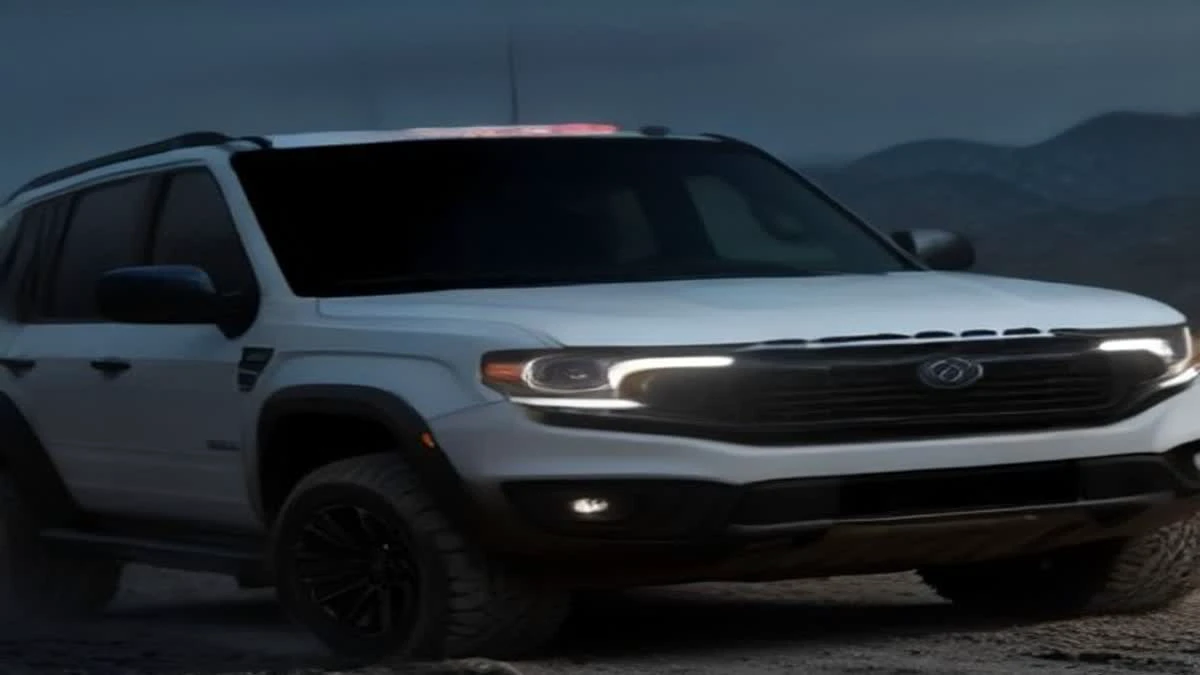
A sloping roofline usually costs you rear headroom. The New G6 argues the other way: a fastback silhouette with a long front overhang and a full-width light bar outside, and power-reclining Nappa leather seats inside, on a car that publishes up to 525 km WLTP and a 10-80% charge in 12 minutes.
Key takeaways
- The New G6 uses a fastback profile with a long front overhang and an integrated full-width light bar.
- Front seats are power-reclining Nappa leather, and availability varies by configuration.
- Two variants are published for Australia: RWD Long Range and AWD, the latter at 4.13 seconds to 100 km/h.
- Both variants sit on a Full-Domain 800V High-Voltage SiC Platform with 5C supercharging.
What a fastback actually changes
A coupe roofline is a packaging decision, not just a styling one. The roof starts falling earlier, so the visual weight of the car sits lower and the rear looks shorter than it is. The New G6 leans into that with a fastback silhouette that carries the roof line through to the tail rather than breaking it with a stepped rear window. The long front overhang in front of the windscreen adds the opposite effect, stretching the nose and giving the cabin more visual space behind it. The practical question is whether the shape costs you room, and the site's own interior claims are the place to check rather than the silhouette. Everything quoted in this piece comes from the page for this XPENG electric suv australia on the manufacturer's own site, so the numbers are the brand's, not a magazine's.
Lights, surfaces and the family car problem
The full-width integrated light bar is the most recognisable element, running clean across the front and tying the two sides together. It is the detail that makes the car read as one piece at night instead of a collection of panels. Buyers with children tend to care less about that than about doors, belts and the surfaces that cop the school bag treatment, and here the site stays descriptive rather than numeric: the cabin uses the fastback shape to keep a conventional five-seat layout rather than trying to squeeze in a token third row. That is the right call for most households, because a genuinely usable third row needs the length most mid-size coupe SUVs do not have. If a third row is non-negotiable rather than nice to have, the honest comparison is the seven-seat X9 rather than a coupe body trying to fake one.
Nappa seats and the footnote you should read
The published interior specification includes power-reclining Nappa leather seats. That is the headline, but the site attaches a qualification: availability of the feature varies by configuration. Read that as a build-sheet instruction rather than small print. If the reclining leather seat is the reason you chose this car over something else, confirm which configuration includes it before you commit to a variant, because trim decisions in Australia are usually made at the configurator stage rather than at the dealership. The Xmart OS cockpit is the other half of the interior story: the interface is OTA-upgradable over Wi-Fi or a mobile network, so the software side can change after you take delivery, and it supports customisable in-car scene modes.
Access, doors and the load you carry
Coupe SUVs live or die on the bits between you and the seat: door opening height, sill height and the shape of the boot aperture. None of those are published as numbers for the New G6, so the only honest advice is to test them with the objects you actually carry. Load a folded pram, a large suitcase and a full grocery run, in that order, and see whether the aperture swallows them without lifting over a high lip. The site's design notes point at the long front overhang and the fastback tail, which is a packaging choice that keeps the cabin conventional rather than borrowing rear space for the styling. On the assumption that most buyers load the car in a shopping centre rather than a showroom, that openness is worth more than a fraction of a degree of roof slope.
Two variants, one platform
XPENG publishes two variants for Australia, and the differences are worth understanding before a test drive. RWD Long Range is the efficiency-led choice and sits behind the published figure of up to 427 km of charge added in 15 minutes, which the site's footnote attributes to internal tests of that variant. AWD adds a second driven axle and publishes 4.13 seconds to 100 km/h. Both quote the same 10-80% charge window of 12 minutes and the same 800-volt architecture.
| Point | RWD Long Range | AWD |
|---|---|---|
| WLTP range, model page | Up to 525 km | Up to 525 km |
| 0-100 km/h | Not published on the model page | 4.13 seconds |
| Platform | Full-Domain 800V SiC, 5C supercharging | Full-Domain 800V SiC, 5C supercharging |
| 10-80% charge | 12 minutes | 12 minutes |
| Front seats | Power-reclining Nappa leather, availability by configuration | Power-reclining Nappa leather, availability by configuration |
Worked example: the cost of the shape per 100 km
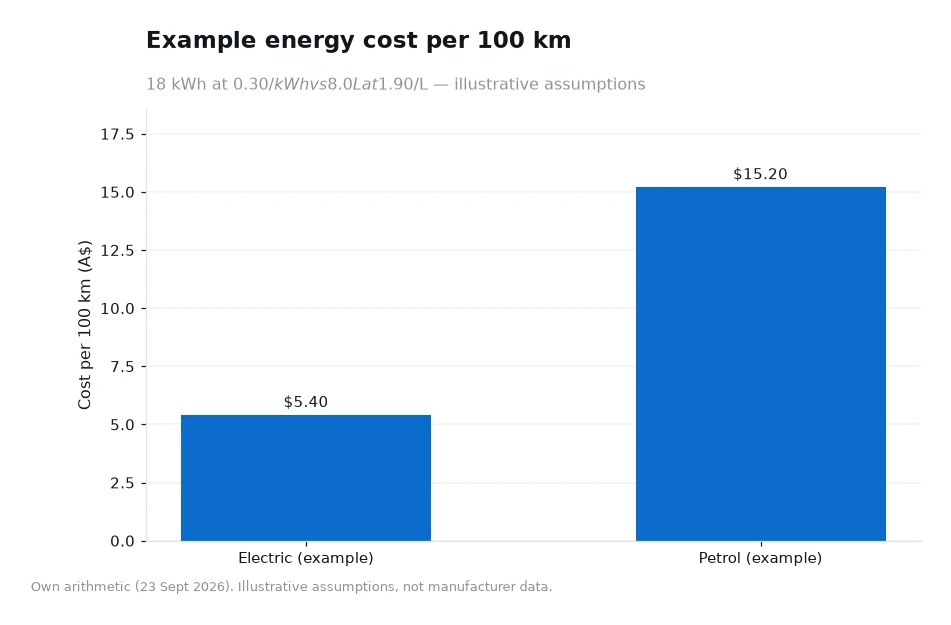
This is my own arithmetic with illustrative assumptions, not manufacturer data, and it matches the chart on this page: 18 kWh of energy per 100 km at $0.30 per kWh, against 8.0 L per 100 km at $1.90 per litre. Electric: 18 x 0.30 = $5.40 per 100 km. Petrol: 8.0 x 1.90 = $15.20 per 100 km. The gap is 15.20 - 5.40 = $9.80 per 100 km, which is 65% of the petrol figure. Over an assumed 15,000 km a year that becomes 15,000 / 100 = 150 units of 100 km, so 150 x 5.40 = $810 for the electric figure and 150 x 15.20 = $2,280 for the petrol one, a difference of $1,470 across the year. Change any single assumption and the gap moves; the point is the shape of the calculation, not the exact numbers.
Frequently asked questions
Does the coupe roof cost rear passengers headroom?
The Australian model page does not publish a headroom measurement, so treat any figure you read elsewhere as unverified. What the page does describe is a fastback silhouette with a conventional five-seat layout, and the practical check is to sit in the back seat during a test drive with the seat set where you would actually use it.
What is the difference between the RWD Long Range and AWD variants?
Both are published on the same platform with a 10-80% charge window of 12 minutes and a WLTP range of up to 525 km. The AWD adds a quoted 4.13 seconds for 0-100 km/h. The RWD Long Range sits behind the published figure of up to 427 km of charge added in 15 minutes, which the site attributes to internal tests of that variant.
What to check on a test drive
Set the driver's seat first, then sit behind it, because reclining front seats move further back than a fixed backrest. Take a pram, a school bag or a bike helmet with you if that is what the car has to swallow, and load it before you drive rather than after. Then confirm on the build sheet which configuration carries the reclining Nappa leather seats, since availability varies, and ask the dealer how the Xmart OS interface has been updated on the demonstrator you are driving. The Australian range page is the fastest way to see what the New G6 sits next to, including the L03 still listed as coming soon.
Published dimensions, range figures and charge times in this article come from the manufacturer's Australian model page as read on 23 Sept 2026. WLTP range depends on conditions, and Nappa leather seat availability varies by configuration. Confirm the build sheet for your chosen variant before you sign anything. [1]