Five Inspection Steps Behind Every Brewery Tank Shipment
A brewery tank is not signed off once; it is signed off five times before it is crated. The manufacturer Hermann Biological Engineering publishes five inspection steps on every shipment — materials checking, production process, jacket pressure testing, packing and loading inspection, and a finished-product leak test — and the inspection record travels with the order. Each vessel also carries a data plate with its pressure-testing record and serial number, which is what makes a question about a weld traceable two years later.

Key takeaways
- Five published checkpoints cover materials, production, jacket pressure, packing and loading, and the finished leak test.
- Every tank leaves with a data plate carrying its pressure-test record and serial number.
- Goods travel in wooden boxes with a checking list that can be matched against the packing plan.
- Published warranty wording: 6 years on tank accessories and electronic components against manufacturing defects from the factory, used within scope.
Why one final test is not enough
A leak test at the end of building finds a hole. It cannot find the wrong steel grade, a jacket wall thinner than the drawing, or a tank that sat on its side for six weeks. Splitting quality control into five published stages puts each possible fault where it can still be corrected at the lowest cost: raw plate before it is cut, welds and fit-up while the vessel is still open, the cooling jacket before insulation and cladding hide it, and the finished tank before it is nailed into a wooden box.
The jacket is the strongest argument for the sequence, because the jacket is the part you can no longer see once the tank is clad. A pressure test at stage three is a test on bare steel with your own eyes on the gauge. The same test after cladding is a test nobody will repeat without cutting the insulation open and paying for the repair twice.
The five checkpoints in plain terms
First, materials checking: mill certificates and plate thickness are compared with the order before cutting begins. Second, production process inspection: dimensions, fit-up and welds are examined while the vessel is being built, not afterwards. Third, jacket pressure testing: the cooling channel on the body and on the cone is pressure-tested and the result is written into the file. Fourth, equipment packing and loading inspection: each item is ticked against the packing plan as it goes into its box. Fifth, a finished-product leak test on the completed tank, recorded on the data plate that stays with the vessel for life.
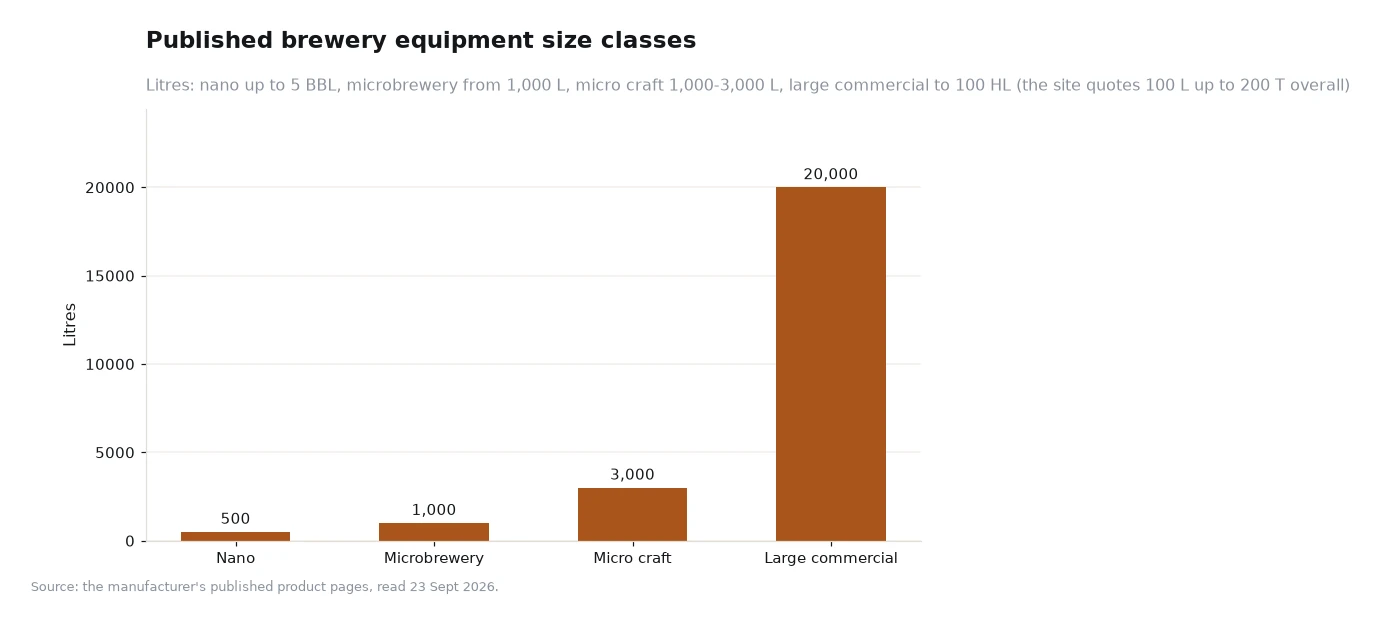
Hermann has designed craft brewing equipment for 23 years and installed plant in more than seventy countries, from the United States, Canada and Mexico to France, the Netherlands and the Nordic region; the company background sets out that record. The published hem brew system range runs from a 200 litre nano kit through 500, 1,000 and 2,000 litre vessels to a 10,000 litre brewhouse, and every size in that range goes through the same five-stage routine before dispatch.
What the paperwork should let you do
Ask for three documents before the container is sealed: the inspection record covering the five stages, the checking list that travels with the shipment, and the pressure-test details stamped on the tank data plate. Together they answer the three questions a head brewer actually has. Which vessel is this, and where does it sit in the order? What was it tested to, and on what date? Who signed the test off?
Keep the same three documents after installation, filed by serial number. If a gasket weeps or a fitting seeps in year two, the plate ties the tank back to a specific inspection record and a specific build date. Without that link, a conversation about a defect turns into a conversation about proof, and the brewery carries the cost of the argument.
Inspection, packing and the last mile
Packing is an inspection step in its own right rather than an afterthought. Equipment is packed in wooden boxes, and the loading check compares the boxes on the truck against the order before the doors close. That is the moment when a forgotten valve, a spare sight glass or a set of pump seals is still cheap to correct; once the vessel is at sea, a missing part costs a second shipment and a second customs entry.
Service access is the other item worth confirming on the day the tank lands. The manufacturer keeps sales staff and engineers online 24 hours, with 7×24 after-sales cover, so a commissioning question raised on a Sunday evening still reaches a person. Installation, commissioning and operator training sit in the same service package when they are written into the purchase order rather than assumed, and the brewery equipment range shows which vessels that cover reaches. The contact page is the quickest way to put a commissioning question in front of an engineer.
Comparing the five checkpoints
| Stage | What is inspected | Record to request |
|---|---|---|
| 1. Materials | Steel grade and plate thickness before cutting | Material certificates tied to the order number |
| 2. Production | Dimensions, fit-up and welds during fabrication | In-process inspection sheet for the vessel |
| 3. Jacket pressure test | Cooling channel on body and cone, before cladding | Pressure-test entry with date and result |
| 4. Packing and loading | Order items against the packing plan and boxes | Checking list shipped with the goods |
| 5. Finished leak test | Completed tank after assembly and fittings | Data plate with serial number and test record |
Worked example: the price of finding a fault late
Assume an order of a 10 BBL brewhouse, which the manufacturer's own chart treats as about 1,174 litres, plus four 10 BBL fermentation tanks, delivered inside the published window of 90–150 days from deposit to door delivery. Now assume the inspection team finds one jacket weld that has to be redone at stage three, and that the rework takes four working days. Four days against the fastest published schedule is 4 ÷ 90 = 4.4% of the window, and production continues around it.
Move the same fault to stage five, after the jacket has been insulated and clad. Add three days to strip and re-clad, so the delay becomes 4 + 3 = 7 days, and 7 ÷ 90 = 7.8% of the shortest published schedule. Now suppose the fault only shows itself after the tank is on site: 35 days of sea freight plus a six-day service visit for a repair crew means 41 days away from production, and 41 ÷ 90 = 45.6% added to the fastest published window. That arithmetic is an example built on stated assumptions, not a quotation, but it explains why the third checkpoint is the least expensive place on the line to catch a problem.
Frequently asked questions
How many inspections does a shipment get?
Five published stages: materials checking, production process inspection, jacket pressure testing, packing and loading inspection, and a finished-product leak test. The record for each stage travels with the order, and the tank data plate carries the pressure-test entry and serial number.
What does the warranty cover and for how long?
6 years on tank accessories and electronic components against manufacturing defects from the factory, provided the parts are used within the scope of the published terms. Wear items consumed in normal service are a maintenance question, not a defect claim.
What to put in the purchase order
Write the five checkpoints into the order document rather than leaving them as an assumption, and name the person who will receive the inspection record. Add the checking list and the data plate details as documents to be handed over with the shipment, and confirm in writing that the crew needs installation and operator training on site.
The other clause worth adding is a photographic record at stage three, taken with the gauge visible. A single photo of a pressure test on bare steel costs nothing to take and closes most later arguments. Breweries that ask for it once tend to ask for it on every order afterwards.
The inspection stages, size classes and warranty wording quoted above come from the manufacturer's own website, read 23 Sept 2026, and the delay arithmetic is our own example with its assumptions stated in the text.[1] Check the current quotation and order documents for the terms that apply to your own vessel list.